
How To Play Word Limit
A clue-giving party game by Alex TD
Table of Contents
Overview
(Or get the Word Limit App for a quick in-app guide)
A card with six words is visible for everyone to see. You and one opponent are racing to give a single-word clue to indicate the Target Word. Only one clue is given – whoever is first to give the clue claims the chance to earn a point.
But don’t be too fast: your first idea might just as well describe a different word, and the Audience only gets one guess for the correct answer. Not only that, but the clue must obey a Word Limit: a small restriction on the form of the clue word, which reduces what you can say in the first place.
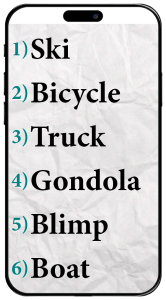
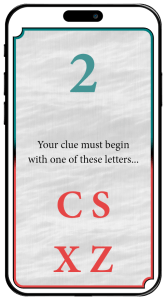
Words
A Word Card provides the set of six words for everyone to see. Clue-Givers need to give a clue to indicate one of these words: the Target Word.
The Target Word is randomly selected: use six Number Cards, roll a die, or use the Word Limit App.
Limits
A Limit restricts what the clue can be, and comes in a few forms:
- Clue Length: 1-4 Letters, 5-6, 7+
- Part of Speech: Noun, Verb, Adjective (or Adverb)
- Starting Letter: T or D, any of AEIOUWY, any of CSXZ, etc.
Play
Choose two adjacent players to be opposing Clue-Givers.
The Clue-Givers are both actively playing at the same time. They are racing against each other to think of a clue first.
The other players are the Audience, who will discuss the clue and pick an answer.
Draw a Word Card, and place it in the center of the table.
There are six words for everyone to see. Someone should read them out loud for everyone to hear.
The Clue-Givers are competing to give a single-word clue to indicate the Target Word.
Give the Limit Cards to the Clue-Givers.
The Clue-Givers randomly and secretly determine the number of the Target Word.
Then they get a random Word Limit which determines what form the clue must take.
Then, it’s a race!
Whoever is first to shout out a clue claims the chance to earn a point.
The Audience discusses which of the six words they think the clue is for, then picks one word as their final answer. If the Audience chooses the Target Word, that Clue-Giver earns a point. Otherwise, the opposing Clue-Giver gets the point.
Continue playing with the same Word Card and Clue-Givers, but a new Target Word and Limit.
Once a Clue-Giver has four points, they win the match.
A new match continues the game with two new Clue-Givers, and a new Word Card.
Detailed Walkthrough
These are more thorough rules for clarity, and tips for a smooth game.
One Match
One match is played with one Word Card and two Clue-Givers who are sitting next to each other.
Choose the side of the Word Card
Opposite sides of the card have different difficulty – noted by the number of dots in the corner. More dots is generally more difficult to give clues for. Both Clue-Givers must agree if they want to use the more difficult side – use the easier side otherwise. (On the App, there are no dots or “sides” of cards – just swipe to the next set of words if you want)
Place the Word Card in the center of the table for everyone to see. Someone should read the six words out loud for everyone to hear.
A match takes a number of rounds to complete – whoever earns four points wins the match. Play up to seven rounds until the match is won.
One Round
1) Target: One Clue-Giver randomly determines the number, which indicates the Target Word: one of the six words from the Word Card. Make sure both Clue-Givers are the only players who can see the number.
2) Limit: First, let a few seconds pass after the number is determined to be sure both Clue-Givers see the Target Word (and are paying attention). The other Clue-Giver then turns up a Limit Card, showing both Clue-Givers but not the Audience. (The App automates this)
3) Clue: Then the race begins! Whoever thinks of a good clue first (that fits the Target Word and Limit) shouts it out, and claims the chance to earn a point (or lose a point).
The opposing Clue-Giver should not say anything now – he has lost the race.
If both Clue-Givers give a clue at the same time – simply re-do the round.
4) Discuss: The Audience now discusses which of the six words they think the clue indicates. During the discussion, Clue-Givers remain passive. The Clue-Giver can only repeat the word for clarity, and cannot even spell it. The Audience does not even see the Limit.
Don’t overthink this part – the Clue-Givers had to go with their first idea, so you won’t often logic your way into the right answer!
5) Answer: Once someone feels confident enough, they clearly declare the final answer for the Audience by saying the word and its number (such as: “Red – five”). So don’t even say the number while discussing, only as an answer!
6) Point: After the final answer is clearly declared, The Clue-Givers reveal the Target Word and Limit (people will be curious what the Limit was). If the Audience was right, the Clue-Giver wins one point: take the Limit Card to track score (On the App, swipe to reward a point). If the Audience chose incorrectly, the opposing Clue-Giver gets the point! If the given clue did not match the Limit (or if anything goes wrong) the point is forfeited to the opponent.
Next round
The match continues with the same Clue-Givers and the same Word Card, but a new Target Word and new Limit. The Target Word might be the same number as a previous round. That’s fine, but no repeat clues are allowed.
Next Match
The next match-up of Clue-Givers should rotate only one player in clockwise order.
So, the “left” Clue-Giver of the previous match now plays against the player on their left. This means, as a Clue-Giver, you play two matches in a row – first with the player on your right, then on your left.
Game End and Scoring
The game ends when you want it to. Why should I be allowed to tell you how long to play?
Scoring depends on the game mode. As the game has been explained so far, there is no tracking score between matches. See later for competitive scoring modes and teams.
Valid Clues
A valid clue must be a single word which matches the Limit. Other than that, there are no general restrictions on the clue: they can be proper names, foreign words, acronyms, grunts – whatever, really. Though you may not spell your clue – homonyms should be confusing! (But maybe if the room is too loud, you can spell it for clarity’s sake)
There are a few suggested restrictions for valid clues:
- No form of the six words in your clue. No “Ran” for “Run”, no “Battle” for “Battleship”.
- No identical clues twice in the same match. Any variations on repeat clues are fine (so long as it matches the new limit, of course).
- Since “single word” is the only strict rule, that means even names like “New York” are invalid.
- Hyphenated words are okay (this one can be contentious).
Of course it’s up to you to use each of these.
There are some clues that are always obviously invalid, like indicating the number on the card, just rhyming with the Target Word, or using a secret code. The clue has to do with the meaning of the word. Basically, any form of clue that makes the game less fun is super invalid.
An invalid clue forfeits the point to the opponent – but you don’t need to go over these details with everyone before playing. They are honesty are pretty intuitive, so they are usually naturally avoided even without explanation. If someone does give an invalid clue without knowing the rule, simply mention it, and re-do the round (or be lenient and give them the point). But from then on, breaking the rule loses the point – you can be too quick and mess up the most basic rules (often enough, people don’t even manage to follow the Limit!)
Play Modes and Scoring
Word Limit works a casual or competitive game. Different Play Modes determine who is part of the Audience and how you track score.
Casual Modes
Party: This classic casual mode is how the game has been explained so far. Party mode allows people to come and go as they please. Whoever is listening is a member of The Audience and can discuss the clue. Anyone can declare a final answer (without discussion, if they dare). No score is tracked between matches, but Clue-Givers win individual matches.
Party Voting: This even more casual mode doesn’t wait for agreement between the Audience. Each player simply says which answer they think is correct. There is no final answer given – Clue-Givers wait for maybe 5 seconds after the Audience seems to be done talking, then reveal the answer, and score a point if more people answered correctly than not.
Scoring Modes
These modes track score between matches. Play two full rounds so everyone plays four matches, and compare scores at the end. Or don’t. Again, I’m not going to tell you when to end, or how long to play.
Teams: A scoring mode with two teams. Best with 6 or more players, but four technically will work. Every other player around the table is on a team – so adjacent Clue-Givers are naturally on opposing teams. Only the players who are on the team of the Clue-Giver who gave the clue are part of The Audience. They discuss and reach a consensus to declare a final answer. When a team wins a match, they win the Word Card, and the most Word Cards wins when the game ends.
For an odd number of players, one pair of adjacent players will be on the same team – since you will skip over a clue-giving match with that pair, these players only give clues for one match instead of two.
Free-For-All: Everyone tracks their own points, and even the Audience members can earn points each round.
Clue-Givers earn points normally for correct answers, but also keep that score between matches. The final answer is determined by a vote from the Audience, instead of a consensus. Each member of the Audience declares a word as their own answer (perhaps by holding up fingers). The most popular answer determines the final answer for the Clue-Giver’s score (ties are considered a failure and the other Clue-Giver gets a point).
Players who answered correctly also score: they get one point for each other Audience member who disagreed (whether or not they were in the majority). Of course this means if no one disagrees, no points are earned by the audience. So, easy clues don’t reward the Audience, but do reward the Clue-Giver.
Note: There will be no discussion before answers are declared: you don’t want to help the other Audience members. That shouldn’t take more than 30 seconds. So, after the answer is revealed, go ahead and discuss the clue before the next round.
After each match ends, everyone keeps the points they earned.
You should probably play long enough so that everyone is a Clue-Giver the same number of times.
Two Player: It’s possible, but not as great, to play with two players. One Clue-Giver and one guesser. There is no race, so instead play against a 2-minute timer, to get as many points as you can within two minutes. The timer is still running while the guesser thinks, so guess quick.
Minor Adjudications
Adverbs are acceptable for the Adjective Limit.
The Clue-Giver may quickly correct a clue they gave which doesn’t match the limit, by elongating the word: For example: “Bone…s” to match a “5-6 Letters” Limit, or “educate…tion” to match “Noun”
If both Clue-Givers simultaneously give clues, the round is normally re-done. But if one of the clues is invalid, the point is forfeited to the opponent.
Addendum
Some truly unnecessarily detailed notes:
Surrendering
The opposing Clue-Giver may surrender the point if they know they have no chance because the clue is so good, but the Audience is just taking so darned long. Also, excessive discussion should be cut short if the Limit doesn’t even match the Clue.
Variations
Minor variations of play are a fun experiment:
Sometimes I wake up in the middle up the night with brilliant ideas for the game. Then after my brain wakes up, I realize they are terrible. Here’s an example: Multi-Word Limit. Give a clue to indicate multiple words at once. The Audience has to decide which words match the clue. They don’t even know how many. That has to not work, right? Well here are some variants that do work:
Rhyme Limit: 2+ players. There is no Word Card. Instead of the normal six words, every word that rhymes with some given word is a possible answer. Perhaps start with someone’s name, like “Bart”. So Art, Cart, Fart, Tart, etc., are all possible answers. There is only one clue-giver, but they draw a Limit like normal. After giving the clue, there is no final answer: the Audience shouts out their guesses and the first to name the correct word becomes the new Clue-Giver. Play with the same rhyme for a while, but eventually go onto a new word.
Codenames variant: This is not Word Limit, but I’m going to write this down here anyway. Did you ever notice that each Codenames card has two very different words on either side? Matching those two words would be hard to give a clue for… so let’s make a game of that!
A single clue-giver draws 6 cards and chooses one card to give a clue for – a single clue that matches both sides at once, and isn’t confused for the other 10 words in play (2 sides of 5 other cards). Decide on a card and a clue, then stand the cards up, and line them up in the middle of the table, so that half of the Audience can see one side of the cards, and the other half sees the other side. They both hear the same clue, and pick a card that matches — and you all cheer if it’s the correct card! Pick it by numerical order – saying the word itself can be a clue for the other side.
To be most efficient, start the game with a Thinking Phase, where everyone prepares their own set of 6 cards and a clue ahead of time. It can take a few minutes. (Write it down because you’ll forget it). Then, once everyone has a clue ready, one person stands up their cards and gives the clue. The Audiences comes to a consensus and picks a card. Then the next player, with clue already prepared, sets up their six cards, etc.
Even more difficult variants include: more than 6 cards; Randomize which card to give a clue for; Give a clue for every card (Give the clues in a random order and write down what numerical order they’re supposed to be in. This variant probably means harder cards will be whittled down with the process of elimination so it won’t be that bad.)
A Note on Card Difficulty
One dot indicates easy, two medium and three hard. (Note: the App does not indicate this) In the context of Word Limit, “difficult” means clues that are good for one word will often work for other words on the card as well. “Easier” sets of six words means you probably don’t have to worry too much about a clue being confused for another word. Word sets that seem similar are often actually easy to give clues for: The “animals” cards seem similar, but there are so many ways to describe and differentiate animals.
Though it is sometimes tough to think of a clue on an “easy” card – like a Verb to indicate the target word “Red”. That’s one dynamic of this game. But once you think of “bleed” as a clue – it won’t be hard for the Audience to pick “Red” out of other colors.
Hyphenated Words
Probably the most contentious point of confusion is hyphenated words (if you’re allowing them to begin with). Should it really count as one word? Is that really a “hyphenated word” or just two words you conveniently hyphenated to make a clue? Gosh, that’s hard to make a written rule for. To be more specific in the ruling: if you can argue that the hyphenated words combine to create a new meaning, then it’s valid. So, some valid hyphenated words are: half-baked (not usually about food), mother-in-law (doesn’t really have to do with law), stand-off, twenty-two, real-time. If it’s just “adjective-noun”, or just a grammatical joining of words, then it’s not valid. Invalid: Irish-American, blue-green, private-sector, state-of-the-union, load-bearing, cost-effective. Compound words are always valid.
Timer
There is no timer but honestly, do be quick on the answer. Deep discussion is not generally productive. The clue-giver had to be quick, so it’s not like any serious analysis is going to be accurate. A timer on the clue-givers is unnecessary since it’s a race. Worst case, if they both can’t think of a good clue within 30 seconds, draw a new limit card (and for repeat offenses, use an easier word card).
What even is a verb?
One sometimes gets in the sticky situation of maneuvering the English language in pursuit of verbifying nouns for this game. Well, that won’t stand.
For the purposes of Word Limit, we need to try to solidify the definitions of “Verb”, “Noun” and “Adjective” to make them a little more restrictive. I’m going to say I haven’t done that but I did write all this. So this can be subjective, but there are some solid rules. In general, refer to the root of the word, and ask if the meaning of the word by itself evokes an action (Verb), a description (Adjective) or an object/idea (Noun), not whether you can possibly squeeze it into a different grammatical role in a sentence.
The main solid rule is gerunds, a.k.a. “-ing” words. Those are Verbs in Word Limit. “Flying” is not an Adjective in Word Limit, even though you can grammatically use it as “flying machine”. The real meaning which that phrase evokes is “a machine that flies” – that’s an action. “Flying” is similarly not a Noun when you say “I like flying”. That translates to “I like to fly”- that’s an action.
If there is another word that exists that is dedicated to noun-ifing a verb, that’s fine: “flight” instead of “flying” works as a Noun. And of course some words commonly work for multiple parts of speech – “Limit” for example is perfectly fine as a Noun or a Verb.
Don’t try to force words into uncommon grammatical roles by adding suffixes. Take “slapped”: “slap” + “-ed”. In Word Limit, that’s a Verb. The phrasing of “the slapped face” (used as a description) is not commonly used, and still makes you think “he just got slapped” (an action). Whereas the word “limited” is common enough as an Adjective as well as a Verb: The phrase “We have limited resources” doesn’t evoke the act of limiting, but describes the amount of resources.
Allow commonly used words even if they are just a suffix attached to another word. “Educate” becomes “education” and “educated” which are each common enough to be valid as their own word. “Solidify” just means “to make solid” using the “-ify” suffix on the adjective “solid”, but it is common enough to count as a Verb. “Restrictive” is just “-ive” attached to “restrict”, but it’s also common. So common that I started this section using those two words. Whereas you can’t say “happify” as a Verb (which is apparently a real word in dictionaries?). It is a lot easier to think of examples that pass than examples that would be invalid. But you’ll know them when you see them.
 TDS Games
Leave a comment